
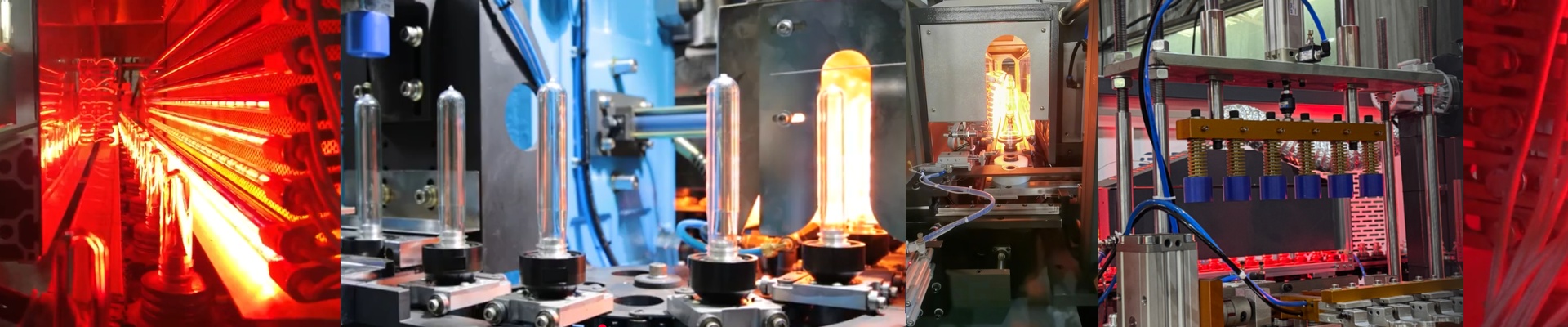
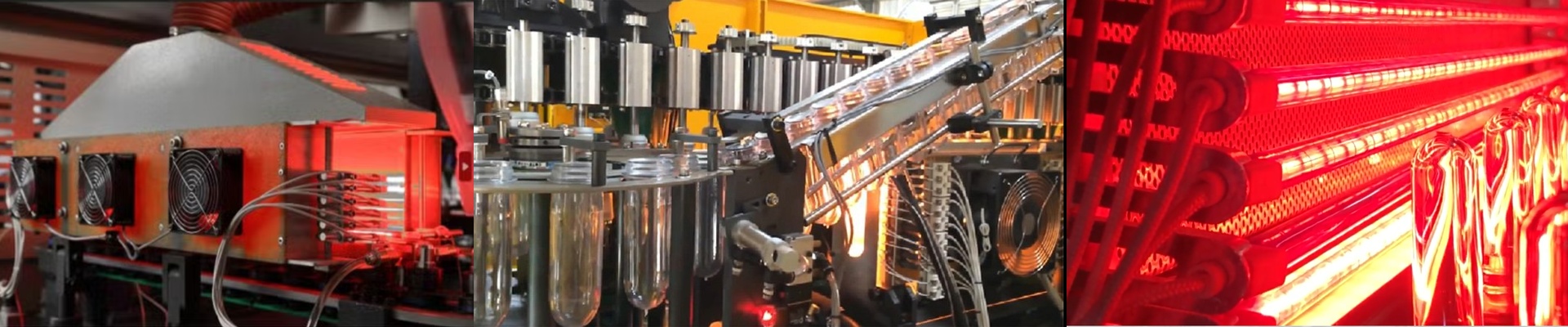
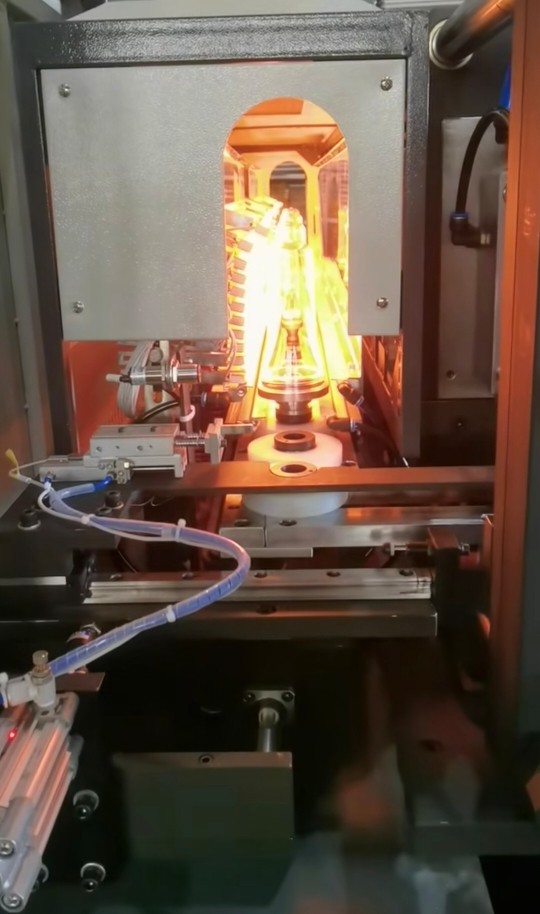
On the blow molding floor, the heating tunnel is where the day’s run gets made or broken. Preforms run too cold, and you’re chasing thin walls and weak stretch. Run them too hot, and you’re staring at crystallization, haze, and a growing pile of scrap. The infrared lamps in that tunnel aren’t just consumables—they’re the knob you turn to control every bottle that comes off the line. When a lamp goes down, there’s no time for guesswork. You need a replacement that matches the original geometry, electrical specs, and thermal behavior—and you need it fast. That’s why more lines are leaning on Made in China IR lamps built specifically for PET preform heating on blow molding machines.
What actually matters, technically
Infrared heating on a PET preform line is all about repeatable, controllable heat delivery. Most preform heating systems use short-wave quartz halogen emitters—fast response, tight focus, and predictable output. Our lamps are built around that reality, with the details that matter when the machine is running.
- **Wavelength and response:**Short-wave IR (typically around 0.78–1.2 µm) gets absorbed efficiently by PET, so the preform surface heats quickly while the core stays stable. That gives you a fast ramp-up and setpoints you can count on.
- **Emitter construction:**The quartz tube is chosen for high thermal shock resistance. In a heating tunnel, that translates to fewer cracks from repeated start/stop cycles and the temperature swings that come with changeovers.
- **Power density and sizing:**We match the standard wattages and lengths used across blow molding platforms, so you can swap lamps without reworking reflector geometry or tunnel layout. Common ratings cover what the preform heating zones demand, and the physical envelope fits OEM reflector systems.
- **Connection and mounting:**Lamp ends are engineered to standard bi-pin bases (like R7s-type configurations), with lead spacing that lines up with existing sockets. That cuts install time and keeps you from having to rewire anything in the field.
- **Electrical compatibility:**Voltage and power specs align with typical blow molder control cabinets and transformer setups. You still need to verify your machine’s nameplate and the existing lamp data, but the goal is a true 1:1 replacement. The point isn’t to over-engineer the lamp. It’s to make it consistent—so your heating curve doesn’t change every time you change a lamp.
Why this works on a PET line
A PET preform line runs on balance: heat, time, and stretch. If the lamps underperform, the heating curve drifts, and you start compensating with higher power, slower cycles, or more scrap. If the lamps overshoot, you get quality issues that don’t show up until the warehouse. Our Made in China IR lamps are designed to keep that balance where it should be.
- **Faster stabilization after lamp changes:**With matched geometry and output, the tunnel gets back to temperature quickly after maintenance. Less time chasing setpoint after a swap means more time making bottles.
- **More stable preform temperature:**Stable output helps reduce temperature spread across preforms. That improves stretch consistency, which shows up as more uniform wall thickness and fewer failures downstream on the filling line.
- **Lower energy per bottle:**Infrared heating is directional—energy goes where it’s needed. When the lamp, reflector, and control strategy are aligned, you avoid wasted heat in the tunnel and reduce the load on cooling.
- **Longer service life under real conditions:**We focus on robust filament design and thermal management to support long runs. In practice, that means fewer lamp changes per year, less downtime for maintenance, and fewer spares to stock.
- **Cost control without sacrificing uptime:**Because the lamps are engineered as drop-in replacements, you avoid long procurement lead times and expensive OEM premiums. You keep the machine running with predictable maintenance cost. This matters especially on high-cavitation machines—Sidel, Krones, SIPA, Husky, SACMI, or Nissei ASB—where a small drift in heating can snowball into thousands of bottles before you catch it.
The stuff you need to know before you spec
No lamp is universal, and no factory floor is exactly the same. Before you spec a replacement, here are the real-world constraints that deserve to be said plainly.
- Match the data, not the label:“Compatible” means nothing unless wattage, voltage, length, base type, and thermal profile line up with your machine’s original lamp. Bring the existing lamp nameplate, your machine model, and your tunnel zone layout to the spec step.
- **Check your control strategy:**If your machine uses closed-loop control with a pyrometer or temperature sensor, the new lamp’s response time and output curve need to be close to the original. Otherwise, the control loop can overshoot or undershoot, and you’ll spend time chasing stability.
- **Reflector condition drives output:**A lamp can be perfect, but a oxidized or dented reflector scatters energy and creates uneven heating. Replace reflectors when you replace lamps—or at least inspect and clean them.
- **Thermal shock is real:**Lamp life drops when you hit a cold start with full power. If your schedule allows, use a controlled ramp-up profile at startup. If it doesn’t, make sure the lamp is rated for the duty cycle your line runs.
- **Get the electrical connections right:**Make sure sockets are clean, aligned, and free of arcing. A poor connection generates heat at the base, shortens lamp life, and becomes a safety issue. If you want the quickest route back to a stable line, start with a lamp engineered as a true 1:1 replacement—same interface, same output envelope, same control behavior. We build Made in China IR lamps for PET preform lines to do exactly that: fit, fire, and run—without forcing you to re-tune the whole blow molder. If you’re spec’ing replacements for a blow molding line, send us your machine model and current lamp specs. We’ll match the parameters and get you back to consistent heating, predictable cycles, and fewer surprises on the floor.