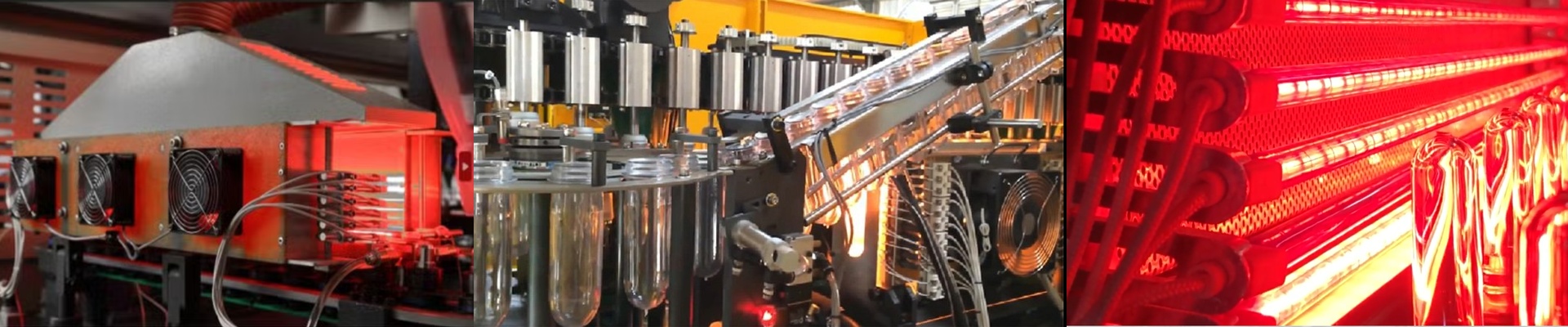
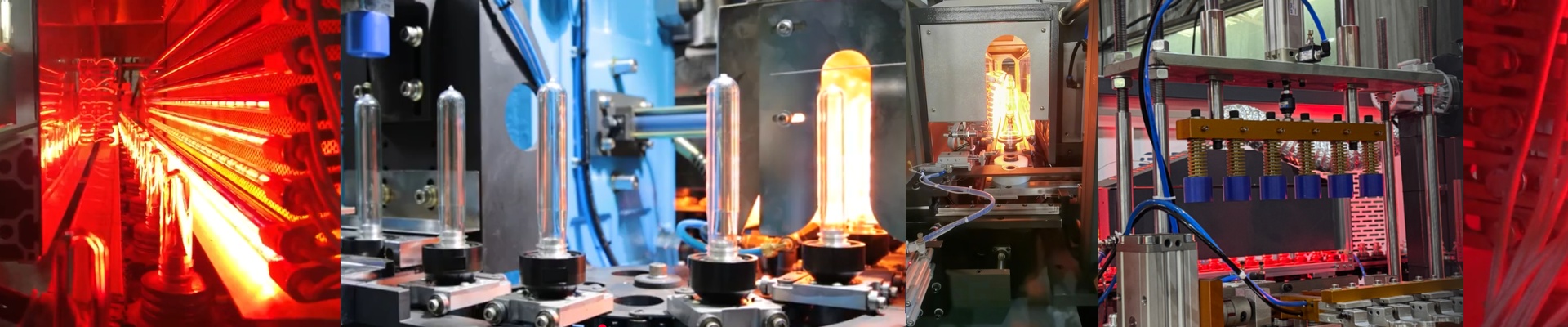

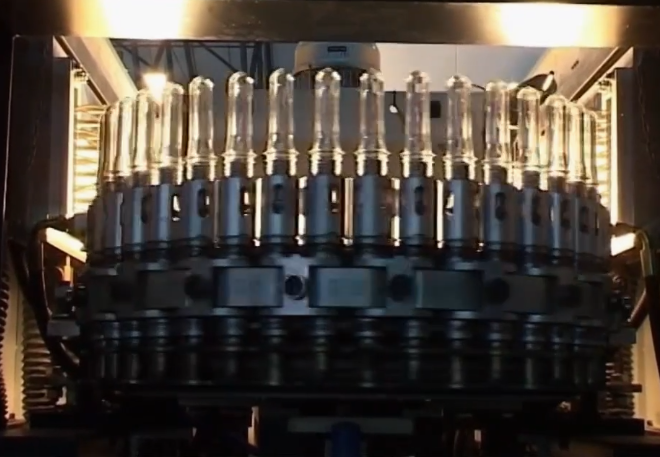
On the blow molding floor, preform heating is where the cycle kicks off — and where most of your variability sneaks in. If the heating tunnel can’t hold a steady temperature, you’re dealing with uneven wall thickness, blown bottles, and a machine that spends more time alarming than producing. Our PETC infrared lamps are built to drop in where you already run, without having to re-tune the whole line. What matters, technically We match the OEM parameters so the lamp performs like the original, right out of the box. On Sidel machines, the quartz halogen infrared emitters run 240V, 2.0–2.5 kW, with standard R7s connectors and 125–180 mm arc lengths, depending on the heating tunnel layout. For Krones lines, we supply 230V, 1.8–2.2 kW emitters with the same R7s termination and tight dimensional tolerances, so belt-to-lamp clearances stay exactly where they should be. On Husky and SACMI equipment, we match 220–240V, 1.5–2.4 kW ratings and the exact lamp envelope lengths, keeping reflector geometry and the focal line consistent. For SIPA, we provide 240V, 1.8–2.3 kW lamps sized to the preform heating zones, with stable spectral output tuned for fast, repeatable heating. In practice, that means you keep setpoint stability within ±2°C and cycle time where it belongs. Why it works in the real world The gains are straightforward. With 1:1 parameter matching, you skip the rework of re-engineering the heating section and the risk of mismatched power density. The lamps come up to temperature quickly, hold a stable preform temperature profile, and cut scrap from overheated shoulders or underheated body. Energy use drops because the emitter is matched to the zone — no over-spec heating, no wasted kW. We’ve seen units run 5,000+ hours with less than 5% output drop, which means fewer changeovers and less downtime. Here are the details that still matter These are direct-fit replacements, but you still need to get the basics right. Confirm the machine model, voltage, wattage, lamp length, and connector type before ordering. Reflectors and mounting brackets need to be clean and properly aligned. Even a small misalignment shifts the hot zone, and you’ll see it as quality drift. Keep the heating tunnel environment clean, too. Dust and residue on the quartz tube cut efficiency and shorten service life. If you’re running higher line speeds, verify the lamp’s response curve supports the faster cycle without temperature sag.